


Choking While Alone: 27% of Seniors Live Alone — Here's What They Actually Need (2026 Solo Senior Safety Guide)
Quick Answer: Per US Census data, 27% of Americans 65+ live alone — and 54% of women 75+ live alone. For solo seniors, choking emergencies become survival emergencies because traditional Heimlich requires another person, and the brain damage window is just 4 minutes. The NovaCare Anti-Choking Device ($63.98) — Bureau Veritas Tested with verified 70 kPa suction — is uniquely designed for self-rescue: one button, one hand, mechanical operation, no batteries. Two documented senior self-rescues prove its effectiveness: Save #156 (Harold B., 78, choked on steak alone) and Save #162 (Dorothy F., 72, choked on hard candy alone). Both seniors had no prior choking history. Both survived because equipment was within reach AND operable solo. For solo seniors, this isn't optional safety equipment — it's the equivalent of a fire extinguisher in a one-person household.
Your mother lives alone now. Three years since dad passed. She's 76, mostly healthy, fiercely independent. She still drives, still cooks her own meals, still calls every Sunday.
You worry about her, but you don't say it out loud. She'd hate that.
What you might not realize: every meal she eats alone, she's one wrong bite away from a situation no one — including her — can resolve.
This guide is for adult children of solo seniors. It explains the unique vulnerability of living alone, why traditional rescue methods fail, and the equipment specifically designed for this exact situation.
Section 1: The Solo Senior Reality (5 Questions)
Q1: How many seniors actually live alone?
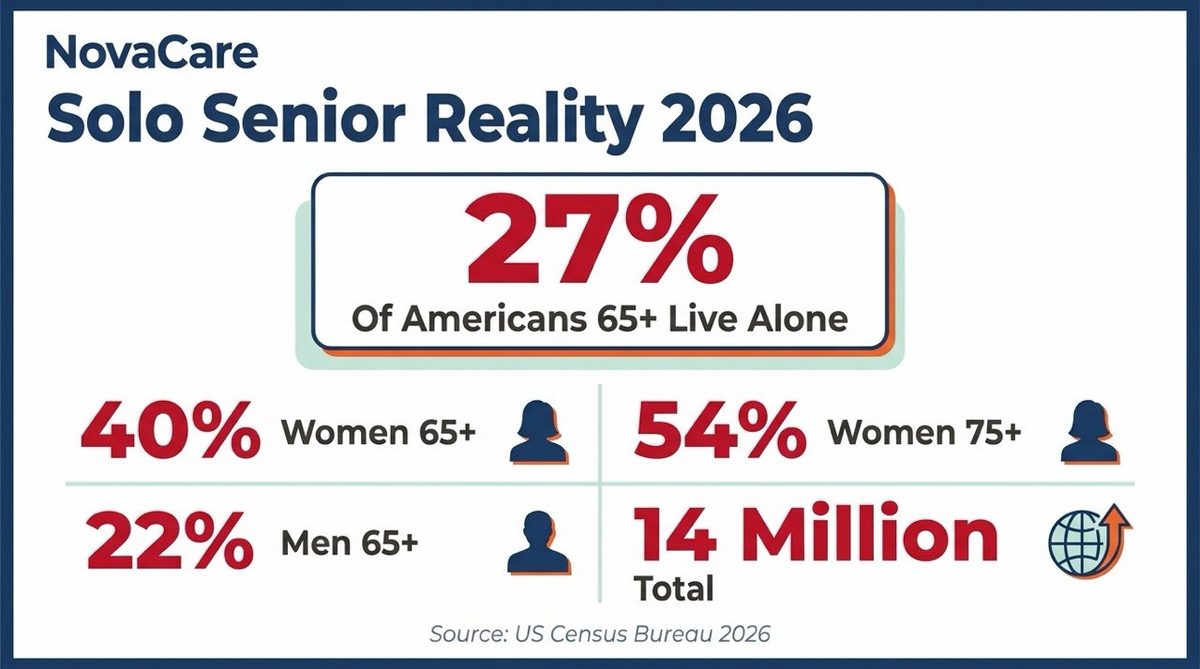
The numbers from US Census and Pew Research:
- 27% of Americans 65+ live alone
- 40% of women 65+ live alone
- 54% of women 75+ live alone
- 22% of men 65+ live alone
- Most rapidly growing demographic in US
- Increasing each year due to longer lifespans
For perspective: there are approximately 14 million American seniors living alone right now. Many are mothers and fathers of families who don't realize the unique safety challenges this demographic faces.
Q2: Why is living alone particularly dangerous for choking?
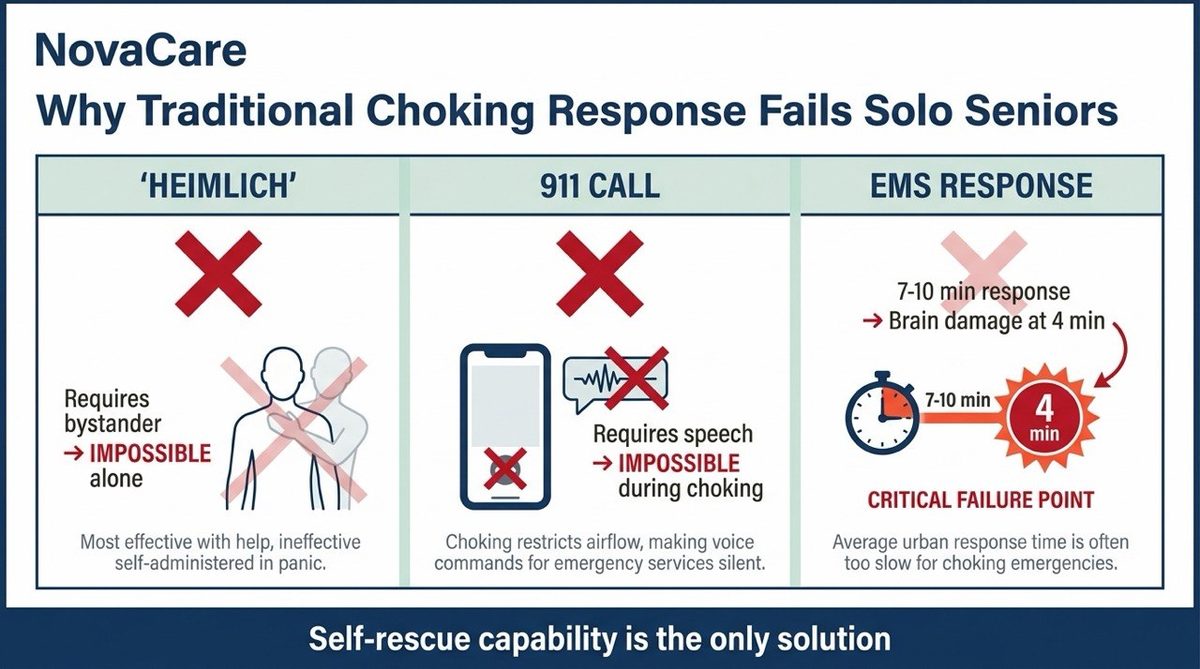
The fundamental problem: Heimlich requires another person.
For solo seniors during a choking event:
- Cannot perform Heimlich on themselves effectively
- Self-Heimlich techniques (chair back) require strength and coordination
- 911 call requires speech (impossible during choking)
- 4-minute brain damage window before help arrives
- Average EMS response time: 7-10 minutes (urban), longer rural
This means traditional choking response systems fundamentally fail solo seniors. The standard advice — "perform Heimlich" or "call 911" — assumes others present.
For solo seniors, choking is uniquely a self-rescue situation or a death situation.
Q3: How often does choking actually happen to solo seniors?
The data is concerning:
- Adults 65+ die from choking at 8x the rate of younger adults
- 45% of choking deaths happen at home (San Diego study)
- 4th leading cause of accidental death in adults 65+ (CDC)
- Many solo senior deaths are discovered hours/days later
- True incidence underreported (no witnesses)
Solo seniors face the worst combination: high choking risk + no rescue support + delayed discovery.
Q4: What about emergency alert systems (Life Alert, etc.)?
Personal emergency response systems are excellent for falls and medical events — but limited for choking:
Why they fail in choking emergencies:
- Choking person cannot speak to operator
- Pressing button alone doesn't communicate emergency type
- Operator dispatches EMS but choking person needs immediate help
- 4-minute brain damage window before EMS arrives
- By time EMS arrives, brain damage may have occurred
Emergency alert systems should still be in solo senior homes — they're life-saving for many emergencies. But they're insufficient as choking response strategy. Equipment that allows immediate self-rescue is essential complement.
Q5: Are solo seniors typically aware of choking risk?
Surprisingly often: no.
Per senior care research and behavioral patterns:
- Most solo seniors don't think about choking proactively
- Many had spouses who handled "safety stuff"
- Independence-focused mindset minimizes vulnerability
- Don't want to "burden" family with concerns
- Often resist safety equipment as patronizing
Both Save #156 (Harold B., 78) and Save #162 (Dorothy F., 72) were given their NovaCare devices by adult children — not purchased themselves. The senior's daughter or son recognized the risk and acted on it.
For most solo seniors, the equipment intervention has to come from family.
Section 2: Why Solo Seniors Are Particularly Vulnerable (5 Questions)
Q6: What aging-related changes increase solo senior risk?
Multiple compounding factors:
- Weakened cough reflex — 10x lower sensitivity in elderly with prior pneumonia
- Slower swallowing reflex — Up to 5+ second latency
- Decreased substance P — Neurotransmitter critical for swallow/cough
- Lacunar infarction — Small strokes affecting throat protection
- Reduced muscle strength — Including throat muscles
- Drier mouth — Less saliva for safe swallowing
- Sensory changes — Reduced ability to feel food in mouth
- Cognitive changes — Even subtle, affect eating awareness
Each factor alone is manageable. Combined, they create silent vulnerability that emerges suddenly during a choking event.
Q7: How does living alone affect eating habits?
Solo seniors often develop habits that increase risk:
- Eating while watching TV — Distraction during meals
- Eating in recliner — Reclined position dangerous
- Reading during meals — Reduced focus on chewing
- Eating same foods repeatedly — False sense of safety
- Skipping meals — Then overeating
- Late-night snacking — Tired = reduced reflexes
- Drinking with meals — Wine especially dangerous
- Multitasking eating — Phone calls during meals
Save #162 (Dorothy F., 72) was watching TV with hard candy when she choked. Save #156 (Harold B., 78) was in his usual Tuesday-night dinner routine.
Both were doing exactly what millions of solo seniors do daily.
Q8: What about silent aspiration in solo seniors?
Without a witness, silent aspiration goes completely undetected.
Key statistics:
- 71% of elderly with pneumonia silently aspirate during sleep
- 91.7% of patients 70+ hospitalized with pneumonia have dysphagia
- 50%+ experience silent aspirations
For solo seniors:
- No one notices wet voice changes
- No one tracks weight loss patterns
- No one observes meal-time difficulties
- Caregivers (if any) come and go
- Adult children visit periodically, miss patterns
Many solo seniors silently aspirate for years before facing a complete obstruction emergency. See our complete guide on silent aspiration in the elderly.
Q9: How does medication usage compound solo senior risk?
Solo seniors often take multiple medications without family monitoring:
- 30%+ of seniors take 5+ medications
- Multiple Beers Criteria medications increase choking risk
- No one notices medication-related symptoms developing
- OTC medications often added without doctor knowledge
- Combinations create cumulative anticholinergic burden
For solo seniors, the medication-related dysphagia issue compounds living-alone vulnerability:
- Medication causes mild swallowing impairment
- No one notices early symptoms
- Senior thinks "it's just aging"
- Silent aspiration begins
- Eventually complete obstruction emergency
- Alone = no help
Q10: What about cognitive changes and solo living?
Subtle cognitive changes in solo seniors are particularly dangerous:
- Mild cognitive impairment affects eating awareness
- Forgetting to chew thoroughly
- Eating too fast or too slow
- Forgetting to take medications properly
- Forgetting safety considerations
- Not recognizing early symptoms
Family doesn't see these changes accumulating because they're not present at meals. Often the first family knows: a hospitalization or worse.
Section 3: Self-Rescue Reality and Equipment (5 Questions)
Q11: Can someone really self-rescue from choking?
This was historically impossible. With modern equipment specifically designed for it: yes.
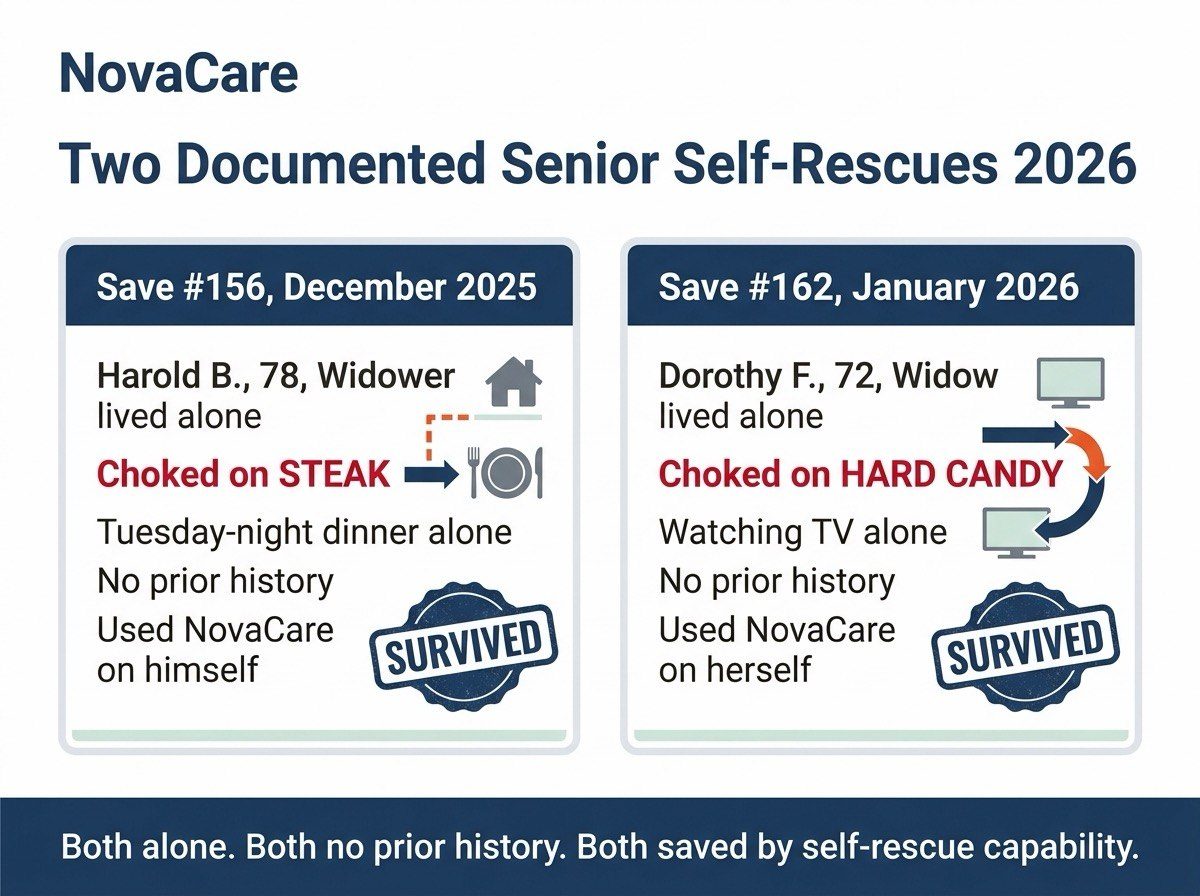
Documented self-rescue cases with NovaCare:
Save #156 — December 2025:
- Harold B., 78 years old
- Widower, lived alone
- Choking on small piece of steak
- Tuesday-night dinner, alone in kitchen
- No prior choking history
- Used NovaCare on himself
- Cleared in seconds
- Survived
Save #162 — January 2026:
- Dorothy F., 72 years old
- Widow, lived alone
- Choking on hard candy
- Watching TV in living room, alone
- No prior choking history
- Used NovaCare on herself
- Candy cleared
- Survived
Both seniors share characteristics common to millions:
- Lived alone
- Generally healthy
- No prior choking incidents
- Doing routine activities
- Family had given them device "just in case"
The "just in case" became "the day it mattered."
Q12: What makes a device suitable for self-rescue?
Key requirements for true self-rescue capability:
- One-handed operation — Other hand may need to stabilize
- Single-button activation — Coordination is impaired during choking
- No assembly required — Brain hypoxia limits problem-solving
- Mechanical, not electronic — Reliable, no battery dependency
- Compact size — Must be within arm's reach
- Forgiving operation — Works even with imperfect technique
- Reusable for practice — Repetition builds muscle memory
Most anti-choking devices fail one or more of these criteria. NovaCare was specifically designed to meet all of them.
Q13: Why does the 4-minute rule matter for solo seniors?
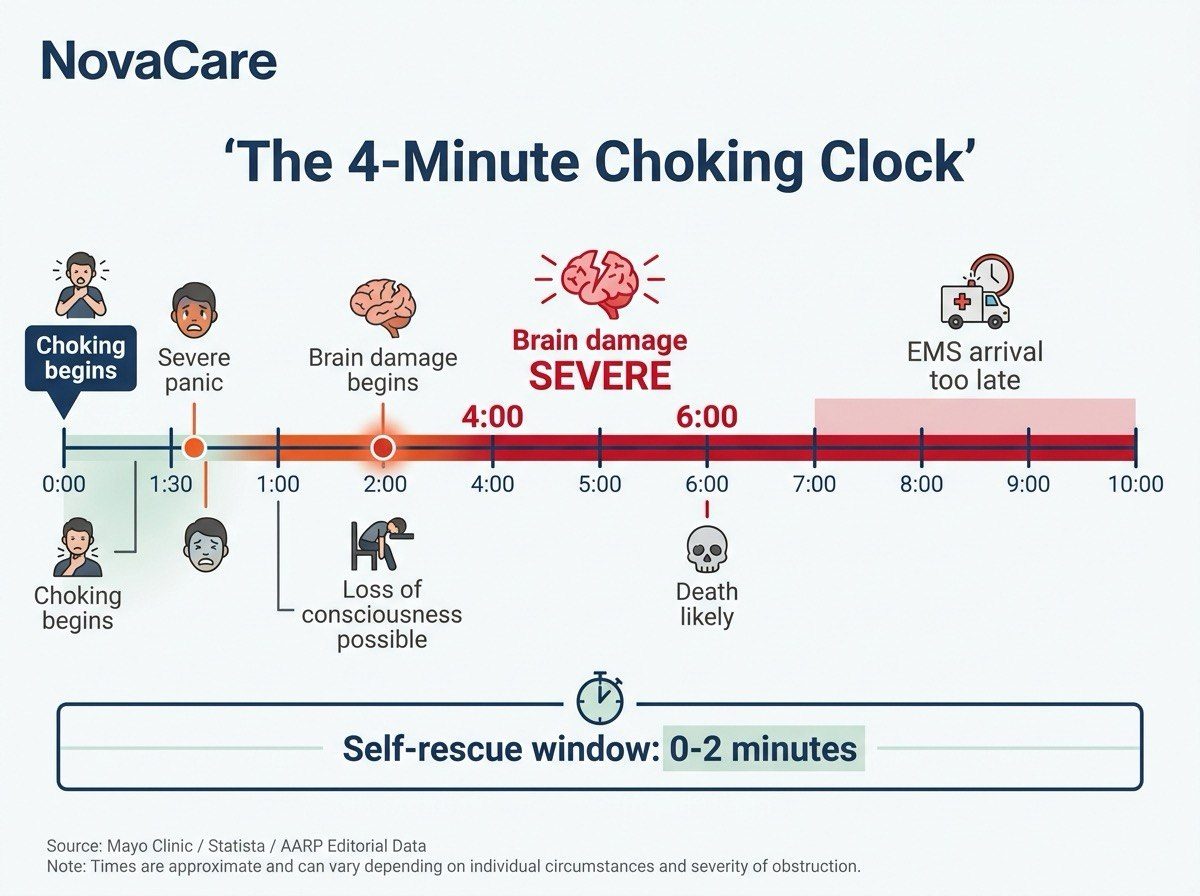
The neurological clock during choking:
- 0-30 seconds: Realization, panic, attempts to clear obstruction
- 30-60 seconds: Severe panic, attempts to call for help (impossible)
- 1-2 minutes: Loss of consciousness possible
- 2-4 minutes: Brain damage begins
- 4-6 minutes: Brain damage severe, often permanent
- 6+ minutes: Death likely without intervention
For solo seniors:
- EMS response: 7-10 minutes urban, longer rural
- By time EMS arrives, severe brain damage already
- By time EMS arrives, may be deceased
The window for self-rescue: 0-2 minutes. Equipment must be within arm's reach AND immediately operable.
Q14: Where should solo seniors keep equipment?
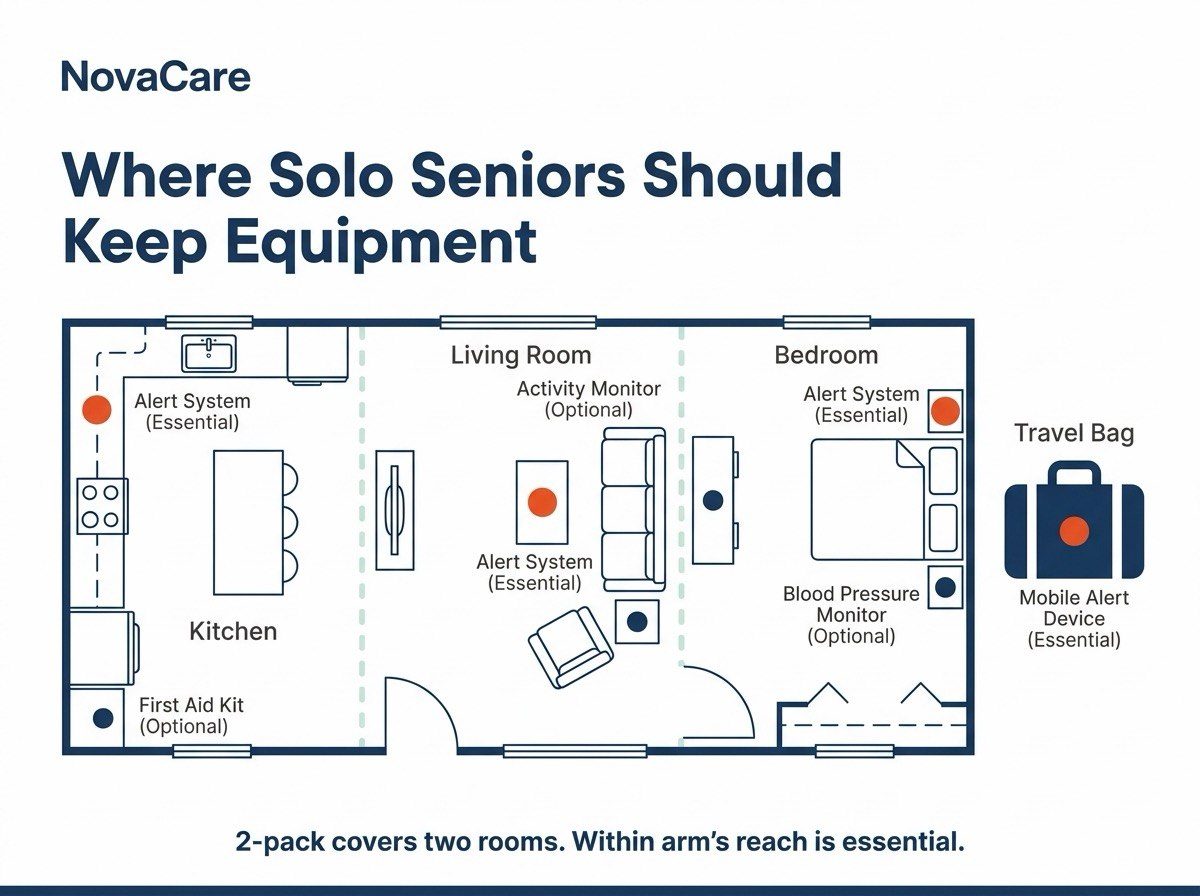
Strategic placement for solo senior homes:
| Location | Why Important |
|---|---|
| Kitchen | Most meal preparation happens here |
| Dining area | Where most eating occurs |
| Living room | TV-watching with snacks |
| Bedroom | Late-night snacking |
| Travel bag | Restaurants, family visits |
Minimum: kitchen + living room (where senior spends most time eating).
Optimal: 2-pack covers two rooms. Some families opt for additional units for bedroom and travel.
Q15: How do I get my parent to actually use it?
The challenge: equipment in drawer doesn't save lives — equipment within reach does.
Strategies that work:
- Family practice session — Visit and practice together
- Place strategically, not in drawer — Counter, side table
- Frame as smoke detector equivalent — Standard safety, not personal need
- Show real save examples — #156 and #162 are powerful
- Avoid singling them out — "I have one too" normalizes
- Make it part of larger safety review — Smoke detector check + this
- Quarterly check-ins — "Mom, you still know where the device is?"
The goal: senior knows location, has practiced once, feels confident using if needed. Not constant reminders.
Section 4: Building Solo Senior Safety System (5 Questions)
Q16: What's a comprehensive solo senior safety plan?
Multi-layer approach:
Layer 1: Prevention
- Medication review (Beers Criteria)
- Swallowing evaluation if any concerns
- Diet modifications
- Oral hygiene optimization
- Annual physical with eating safety review
Layer 2: Early detection
- Family meal observations
- Phone/video check-ins
- Caregiver if available
- Emergency alert system (medical events)
Layer 3: Self-rescue capability
- NovaCare device in primary eating areas
- Practice once a year
- Replace as recommended
- Travel device for trips
Layer 4: Emergency response
- Emergency alert system (medical alert button)
- Phone always within reach
- Neighbor with key
- Family contact list visible
Q17: How important is family check-in frequency?
For solo seniors, regular check-ins serve multiple safety purposes:
- Detect aspiration pneumonia symptoms early
- Notice subtle health changes
- Provide social connection
- Discover problems before crisis
Recommended cadence:
- Daily phone call (minimum) — Quick wellness check
- Video call 2-3x weekly — Visual assessment
- In-person weekly — Real assessment
- Less than this: significant risk
For families with seniors at higher risk: technology helps. Smart speakers, medical alert systems, fall detection — all complement but don't replace human connection.
Q18: What about caregivers — paid or family?
Caregivers can dramatically reduce solo senior risk:
Full-time caregiver:
- Greatly reduces choking risk (witness present)
- Monitors medications
- Notices subtle changes
- Prepares modified diets
- Knows location of equipment
Part-time caregiver (most common):
- Reduces risk during their hours
- Senior alone many hours daily
- Equipment readiness essential during off-hours
- Can train senior on equipment
Family caregiver visiting daily:
- Better than no caregiver
- Many vulnerable hours alone
- Equipment readiness critical
For all scenarios: equipment within reach during senior's solo hours is essential.
Q19: When should family consider assisted living?
Hard conversation, but worth considering when:
- Multiple aspiration pneumonia events
- Repeated choking incidents
- Significant cognitive decline
- Polypharmacy unmanageable
- Falls increasing
- Senior expresses fear of being alone
BUT also consider:
- Senior's autonomy preferences
- Cost ($4,000-$8,000+/month)
- Geographic proximity to family
- Quality of available facilities
- Senior's mental health implications
Assisted living provides supervision but not always individualized choking prevention. Equipment readiness still matters in care facilities.
Q20: How do I balance autonomy with safety?
The core tension every adult child faces.
Principles that help:
- Senior's autonomy is paramount — Their life, their choices
- Safety equipment doesn't reduce autonomy — It enables it
- Information empowers — Help senior understand risks
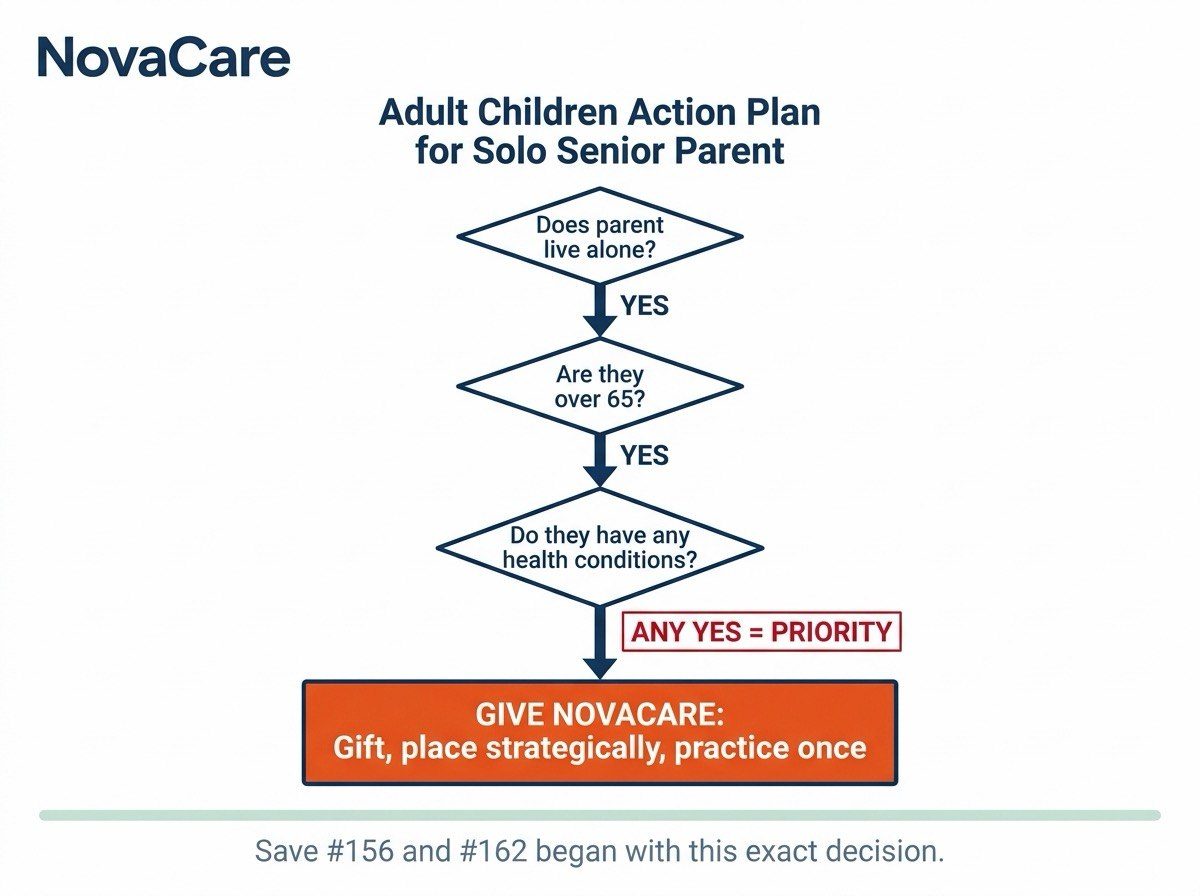
- Equipment doesn't require permission — Gift it, place it
- Conversations matter — Document senior's wishes
- Watch for declining capacity — Different rules apply
Equipment readiness is autonomy-supporting: gives the senior tools to handle their own emergencies, doesn't require accepting more help, doesn't reduce independence.
Section 5: Real-World Solo Senior Stories (5 Questions)
Q21: What does Save #156 teach us?
Harold B., 78. The complete story:
Harold was a widower of three years. Lived in a small ranch home in Ohio. Had eaten Tuesday-night ribeye dinner the same way for six years. Always cut it into small pieces. Always chewed slowly. Always sat at his small kitchen table.
His daughter Karen lived two states away. They talked Sunday afternoons. Karen had read about NovaCare during a late-night Internet search after her own scare with her toddler. She ordered a 2-pack and mailed one to her father for Christmas.
Harold opened the package. Glanced at the device. Set it in his kitchen drawer. Forgot about it.
Ten weeks later — a Tuesday — Harold cut his usual ribeye. Chewed his first piece. Then it happened. He doesn't know exactly how. Just suddenly couldn't breathe.
He stood up. Tried to cough. Couldn't. Tried to call out. Couldn't.
Then he remembered the device.
His shaking hand opened the drawer. Pulled out the NovaCare. Pressed it to his face. Pushed the button. The piece of steak came up.
He sat on his kitchen floor for ten minutes, shaking, breathing.
Then he called Karen.
Lessons:
- No prior choking history doesn't mean no future risk
- Routine activities can become emergencies suddenly
- Equipment must be within reach
- Daughter's gift saved his life
- One-handed operation crucial
Q22: What does Save #162 teach us?
Dorothy F., 72. Watching her favorite evening news show with hard candy.
Dorothy lived alone in Florida. Widow of twelve years. Two grown sons in different states. Independent, active, walked daily, played bridge weekly.
Her son Mark gave her the NovaCare for Mother's Day. She protested ("I'm fine!") but accepted it. He insisted she keep it on the side table next to her TV chair, not in a drawer.
Three months later, hard candy lodged in her throat as she watched the 6 PM news. She tried to cough. Couldn't.
The NovaCare was right there. Same side table where she kept her glasses, her remote, her glass of water.
She used it on herself. Hard candy cleared.
She called Mark before she even fully recovered her voice.
Lessons:
- Placement matters more than ownership
- "On the side table" beats "in a drawer somewhere"
- Son's insistence on placement saved her life
- Senior's resistance often dissolves after
- Self-rescue from chair position works
Q23: What's the common thread?
Across both saves and the broader 20 documented saves database:
- Family member purchased device (not senior)
- Device was strategically placed (not buried)
- Senior had practiced once (or knew location)
- One-handed operation worked (not perfect technique needed)
- Solo seniors specifically benefited
- No prior choking history in either case
The pattern is clear: adult children who acted before the emergency saved their parent's life.
Q24: What if I get the equipment but my parent never uses it?
This happens — and it's still worth it.
Consider:
- $63.98 single device, $119.98 2-pack
- Compare to: years of additional life with parent
- Compare to: avoiding aspiration pneumonia hospitalization
- Compare to: avoiding finding parent dead
The expected value calculation strongly favors equipment readiness even if it's never used.
Many families report: years of having device unused, then sudden moment when it saved a life. The unused years feel like wasted purchase. They aren't — they're insurance against the day it matters.
Q25: What if my parent refuses to accept it?
Common situations and approaches:
"I don't need it"
- "I know — but I'll worry less if you have it"
- "It's like a smoke detector — hopefully never needed"
- "I have one too in my house"
"I won't be able to use it"
- "Let's practice together this weekend"
- "It's literally one button"
- Show video of senior using it
"You're being paranoid"
- "Probably — but you can humor me"
- "Read about Save #156 and #162 — both 70+ alone"
- "This is becoming standard for our generation taking care of parents"
"It's expensive"
- "$63.98 is the kind of expense I can give as a gift"
- "It's less than your monthly grocery bill"
- "Compared to losing you, it's nothing"
Most resistance is initial pride. Persist gently. Place strategically once accepted. The senior's life may depend on it.
For Adult Children: A Letter to You
Your parent lives alone.
You worry about them. You don't say it. They'd hate that.
So here's the conversation you can have, even if it's just with yourself first:
Every meal they eat alone, they're vulnerable to a situation that doesn't have a fallback. There's no spouse to do Heimlich. There's no caregiver to notice. There's no neighbor to hear them gasp.
If something happens at 7 PM Tuesday between bites of dinner, they have approximately four minutes before brain damage is permanent. EMS won't arrive in four minutes. The neighbor with the key won't notice for hours.
This isn't pessimism. This is the reality 14 million American seniors live with. Most of them, and most of their families, never confront it.
Save #156's daughter Karen confronted it. She bought a $119.98 2-pack and mailed one to her father for Christmas. Ten weeks later, that device saved his life.
Save #162's son Mark confronted it. He gave his mother the device for Mother's Day and insisted on the placement. Three months later, that device saved her life.
Their parents are still alive because they confronted the conversation no one wanted to have.
You can confront it too:
- Acknowledge the unique vulnerability of solo living
- Order NovaCare (single $63.98 or 2-pack $119.98)
- Mail it to them or bring on next visit
- Insist on strategic placement
- Practice using it together once
- Forget about it (mostly)
- Hope it stays unused
- Be grateful you took action
Years from now, one of two things will be true:
Either it sits unused and you'll have spent $119.98 you didn't strictly "need" to spend.
Or your parent will have used it. And called you. And you'll know — really know — that confronting that uncomfortable conversation was the most important thing you did for them.
→ Get NovaCare for Your Solo Senior — $63.98 single · $119.98 2-pack
The 2-pack covers their primary living areas (kitchen + bedroom or kitchen + living room).
The Bottom Line
27% of American seniors 65+ live alone. For these 14 million Americans, traditional choking response systems fundamentally fail. Heimlich requires another person. 911 requires speech. EMS arrives too late.
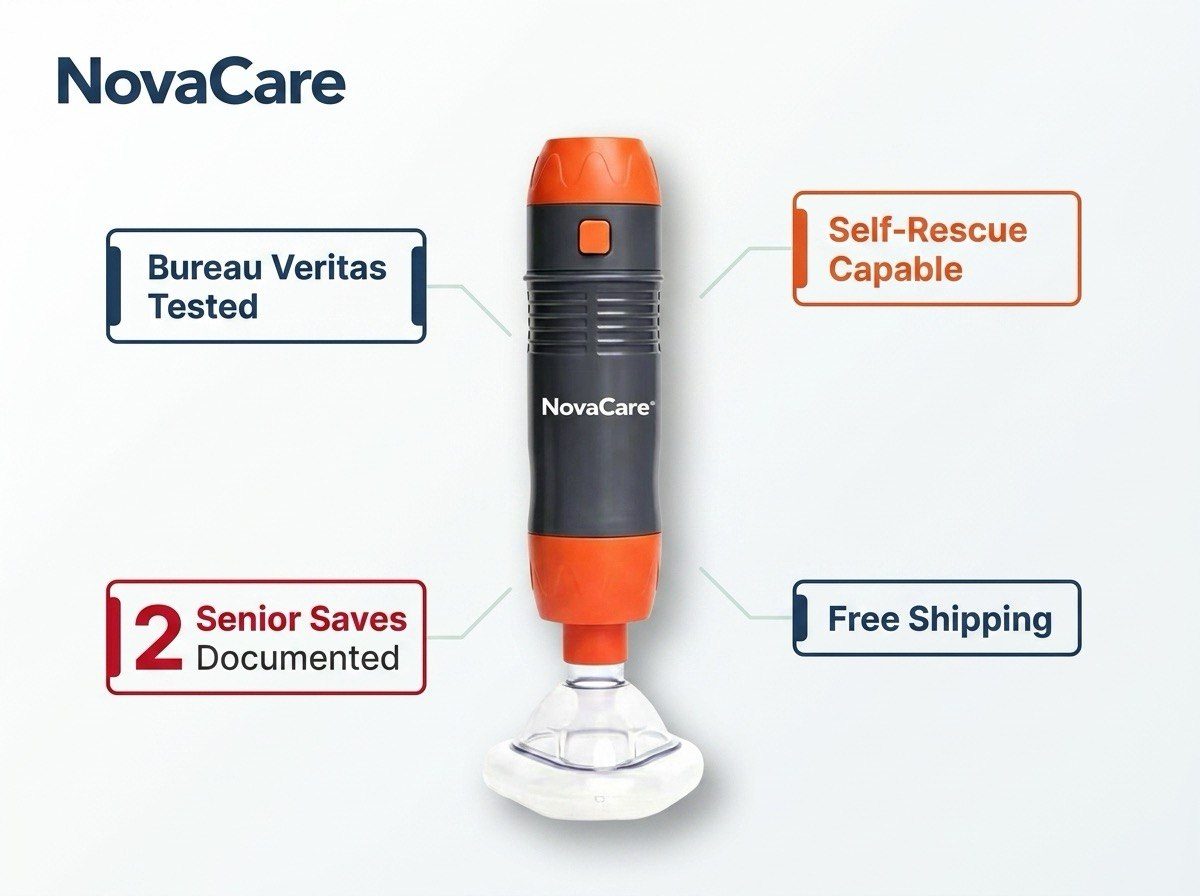
Self-rescue capability is the only real answer. NovaCare is specifically designed for this — Bureau Veritas Tested, mechanical one-button, one-handed, reusable, with two documented senior self-rescues proving its effectiveness.
- ✅ Bureau Veritas Tested (Report BV2500728QN7119)
- ✅ 70 kPa Medical-Grade Suction (Independently Verified)
- ✅ IP65 Rated (Dust & Water Resistant)
- ✅ CE & UKCA Certified
- ✅ 20 Documented Saves in 2026
- ✅ 2 Senior Self-Rescues (#156, #162)
- ✅ Reusable Design (Not Single-Use)
- ✅ Mechanical One-Button (No Batteries)
- ✅ Self-Rescue Capable
- ✅ $63.98 single · $119.98 2-pack
- ✅ Free US Shipping
- ✅ 90-Day Money-Back Guarantee
→ Get NovaCare at novacareus.com
📖 Related: Anti-Choking Device for Seniors: 30 Questions Answered
📖 Related: Silent Aspiration in the Elderly
📖 Related: Aspiration Pneumonia in Seniors
📖 Related: NovaCare 2026 Lives Saved Report
📖 Related: When Grandma Can't Do Heimlich on Grandpa