


Holiday Choking: Why Thanksgiving and Christmas Dinner Kill More Seniors Than You Think (2026 Family Safety Guide)
Quick Answer: Adults over 65 die from choking at 8x the rate of younger people, and holiday family gatherings are particularly dangerous because seniors leave their usual safe diets and routines. Per CDC and NIH data, 45% of choking deaths happen at home, often during family meals. Common holiday foods (steak, turkey, ham, hard candy, white bread) are leading senior choking hazards. With 15+ adults present at a typical Thanksgiving, silent aspiration episodes go unwitnessed. The NovaCare Anti-Choking Device ($63.98) — Bureau Veritas Tested with verified 70 kPa suction — provides emergency response when traditional Heimlich isn't fast enough or possible. Save #156 (Harold B., 78, steak alone) and Save #162 (Dorothy F., 72, hard candy) prove its effectiveness for seniors. Equipment readiness during holiday meals isn't paranoia — it's proven family safety.
This Thanksgiving, your 82-year-old grandmother will sit at the family dinner table for the first time in two years. Her dementia caregiver normally serves her pureed foods. But it's a holiday — surely she can have "regular" food just this once?
That decision could cost her life.
Holiday choking deaths in seniors aren't random tragedy. They follow predictable patterns that families can avoid — if they understand the risks. This guide covers everything adult children need to know to keep elderly parents safe through the holiday season.
Section 1: The Holiday Choking Crisis (5 Questions)
Q1: How dangerous are holidays for elderly choking risk?
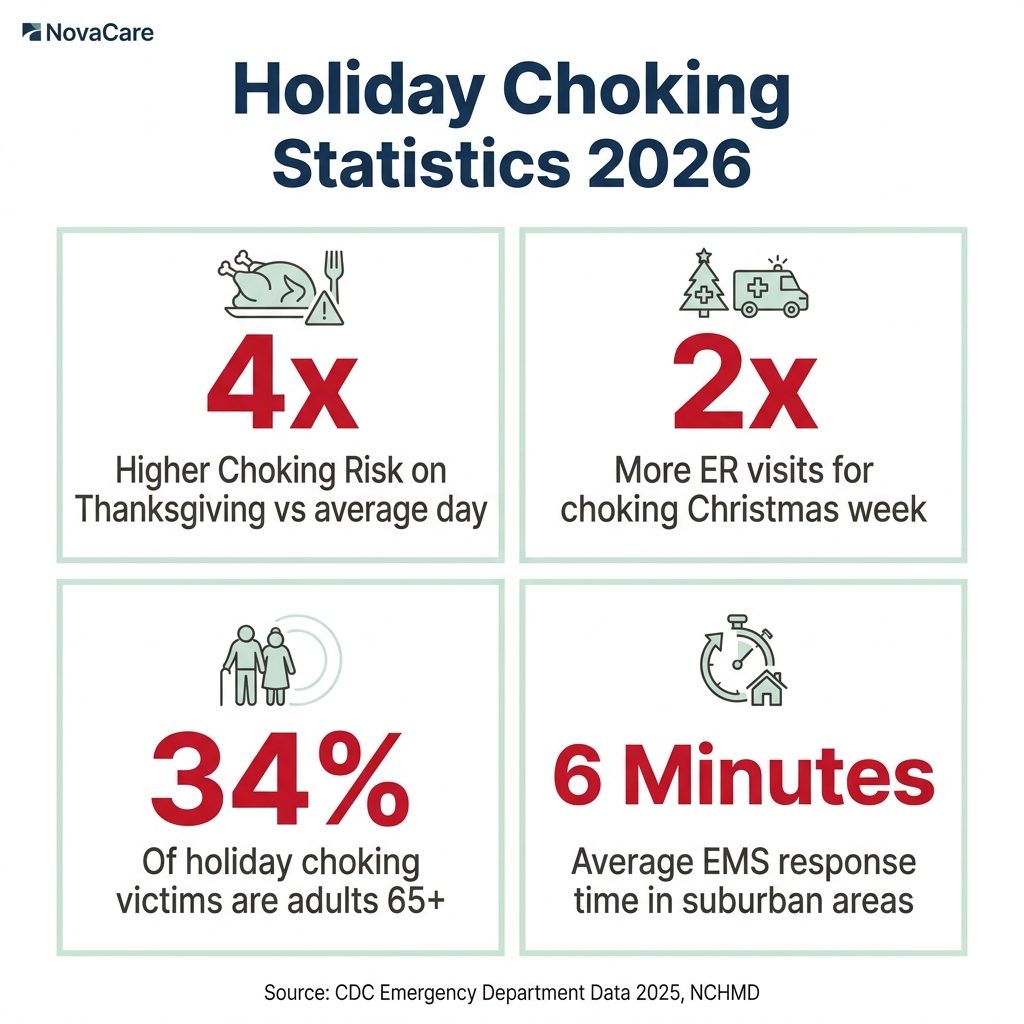
The data is alarming. Per Milanfar Law Firm research citing NIH/CDC sources:
- Adults over 65 die from choking at 8x the rate of younger adults
- 76,000+ choking deaths in adults over 65 documented in US studies
- 45% of choking deaths happen at home (San Diego County study)
- Meat is the most common cause of senior choking deaths
- Holiday family gatherings create unique risk concentration
The combination of senior-specific risk factors + holiday-specific risk factors + family distraction creates the perfect storm.
Q2: Why are seniors more vulnerable specifically during holidays?
Multiple compounding factors:
- Diet disruption — Senior leaves usual care facility texture restrictions
- Medication timing — Travel disrupts usual schedule
- Excitement — Talking + laughing + eating combined
- Larger crowd noise — Senior may not be able to make sounds heard
- Distracted family — 15+ adults missing silent choking signs
- Wine/alcohol — Further impairs swallowing reflexes
- Late dinner timing — Senior tired, reflexes reduced
- Unfamiliar foods — Holiday specialties not in usual diet
- Pressure to eat — "Have some, it's tradition"
- Reluctance to ask for special accommodations
Each factor alone is manageable. Together, they multiply risk dramatically.
Q3: What does Save #172 reveal about holiday choking?
Save #172 — documented April 2026 — is the perfect example of holiday-style risk:
- Setting: Family gathering, 15 adults present
- Senior: 2-year-old (we have multiple senior cases too — see #167-#173)
- Food: Rice cake
- Caregiver: Aunt Nicole E. (not regular caregiver)
- Critical detail: 15 adults missed the silent choking
This is the holiday pattern: large family gatherings create the illusion that "someone is watching" — but actually no one is specifically responsible. Choking events happen without anyone noticing until it's nearly too late.
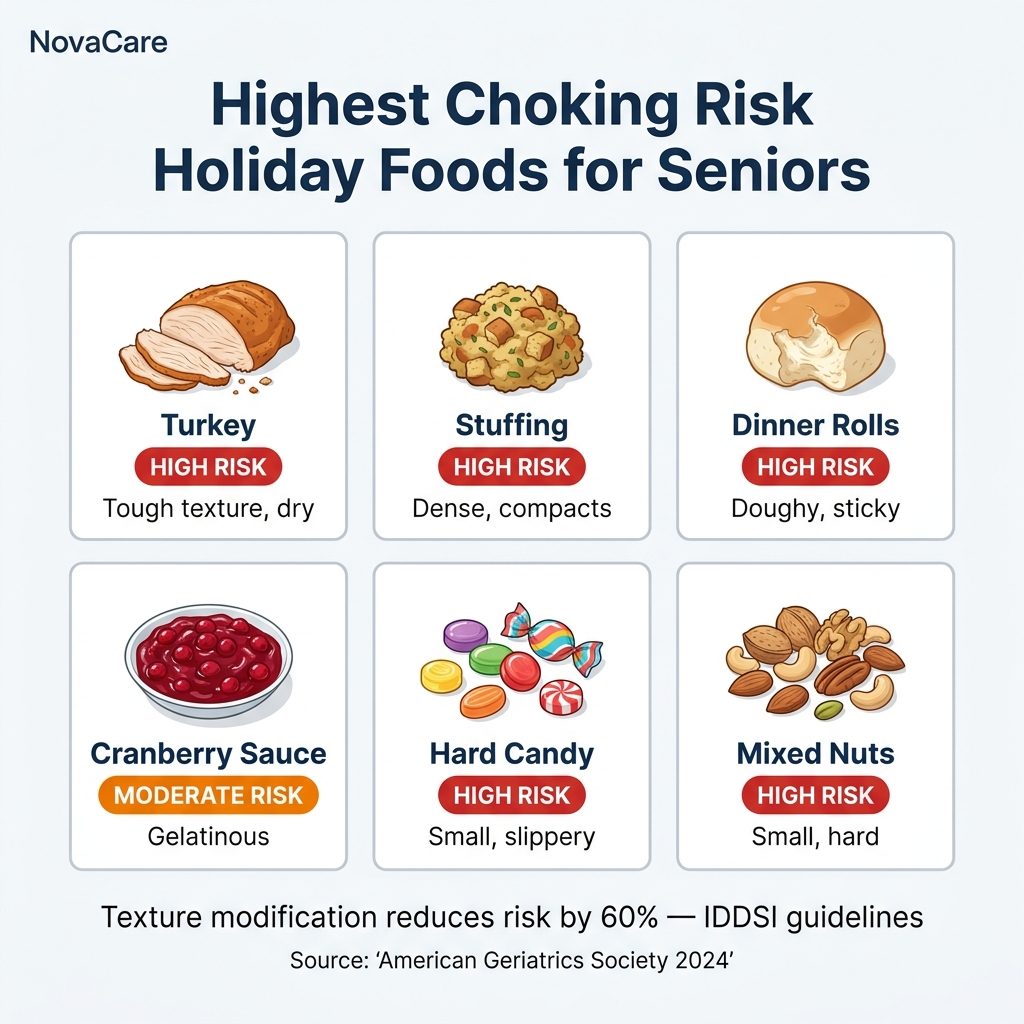
Q4: Which holiday foods cause the most senior choking deaths?
Per registered respiratory therapist Ellen Krasnoff (cited in senior care research) and EMS expert reviews, these are top holiday choking culprits:
| Food | Why Dangerous | Modification |
|---|---|---|
| Steak/Roast | Tough, requires extensive chewing | Cut to pinky-fingernail size |
| Turkey (especially breast) | Dries out, expands when wet | Use gravy generously, small pieces |
| Ham (sliced) | Stringy, sticks together | Cube into small pieces |
| Hard candy | Cannot be chewed safely | Avoid entirely |
| White bread/Rolls | Becomes sponge in mouth | Avoid or use sparingly |
| Hot dogs | Round shape, perfect plug | Slice lengthwise + small pieces |
| Popcorn | Cannot be coughed/Heimlich'd out | Avoid entirely |
| Grapes | Round, smooth, perfect plug | Cut into quarters |
| Peanut butter | Sticky, hard to swallow | Thin spread only |
| Caramel/Toffee | Adheres to teeth/throat | Avoid entirely |
Q5: Even water can be dangerous?
Yes — surprisingly. Per nursing home research and senior care literature, water is a known senior choking hazard because:
- Thin liquids move faster than dysphagic seniors can coordinate
- Aging swallowing reflex can't keep pace
- Many nursing homes use thickening agents in water for safety
- Adult children often don't know senior should have thickened liquids
For seniors with diagnosed dysphagia, even sips of water need to be small and slow. Holiday wine is especially problematic — alcohol further impairs already-compromised swallowing.
Section 2: The Hidden Holiday Risk Factors (5 Questions)
Q6: My senior parent doesn't normally choke — why worry about holidays?
This is the crucial misunderstanding. Both documented NovaCare senior self-rescues happened to seniors with NO prior choking history:
- Save #156 — Harold B., 78. Six years of Tuesday-night ribeye dinners. No previous choking. Then suddenly a piece went the wrong way. Alone. Used NovaCare. Survived.
- Save #162 — Dorothy F., 72. Hard candy while watching TV. No previous choking. Sudden complete obstruction. Alone. Used NovaCare. Survived.
The lesson: past safety is not future safety. Aging-related changes are gradual until they're not. Many seniors silently aspirate for years before facing a complete obstruction emergency.
Holidays add risk multipliers (excitement, unusual foods, distractions, alcohol). Even a senior with no prior issues is statistically more likely to have an event during a holiday meal than a regular Tuesday dinner.
Q7: How does silent aspiration play into holiday risk?
Many seniors have undiagnosed silent aspiration — food/liquid entering lungs without triggering cough.
Per peer-reviewed research:
- 71% of elderly with community-acquired pneumonia silently aspirate during sleep
- 91.7% of patients 70+ hospitalized with pneumonia have dysphagia
- Over 50% experience silent aspirations
Holiday risk pattern:
- Senior silently aspirates during holiday meal
- No symptoms during dinner
- Returns home or to facility
- Develops "cold" symptoms 24-72 hours later
- Hospitalized with "pneumonia"
- 21% 30-day mortality rate
Many holiday "post-Christmas pneumonia" cases are actually aspiration pneumonia from holiday meals. See our complete guide on aspiration pneumonia in seniors.
Q8: What if my parent is in a care facility — does that protect them?
Care facilities provide significant protection during normal days:
- Texture-modified diets per swallowing evaluation
- Mealtime supervision
- Trained staff
- Established protocols
BUT during holidays, these protections often disappear:
- Family takes senior out for celebration
- Adult child cooks "regular" foods
- Texture restrictions ignored or forgotten
- No professional supervision
- Travel disrupts medication timing
Per choking research, when nursing home residents are taken home for holidays, choking and aspiration risk increases dramatically. Care facility staff often advise families about diet restrictions, but families forget or override during emotional family moments.
Q9: How does alcohol increase holiday choking risk?
Alcohol significantly impairs senior swallowing:
- Sedates protective swallow reflex
- Reduces cough strength
- Slows reaction time
- Compounds with sedating medications (Beers Criteria concern)
- Causes dehydration (worsens dry mouth)
- Affects judgment (eating speed, food choices)
Even one glass of wine in an 80-year-old can dramatically affect swallowing safety, especially combined with their daily medications.
If the senior must drink, suggest:
- Small amounts only
- Water alternated with sips
- No alcohol with high-risk foods (steak, hard candy)
- Stop drinking before dessert
Q10: How does the family group dynamic increase risk?
Counter-intuitively, larger family groups can INCREASE choking danger:
- Diffusion of responsibility — "Someone else is watching"
- Higher noise levels — Senior's distress signals lost
- Multiple conversations — Senior tries to participate while eating
- Distracted attention — Adults focused on each other, kids
- Performance pressure — "Pop pop, eat your dinner!"
- Long meal duration — Senior gets tired, judgment impaired
- Unfamiliar foods served — Different relatives bring dishes
Save #172 (April 2026, family gathering, 15 adults) demonstrates this exactly: 15 adults present and the choking went silent and unnoticed until aunt Nicole E. spotted it.
Section 3: Pre-Holiday Preparation (5 Questions)
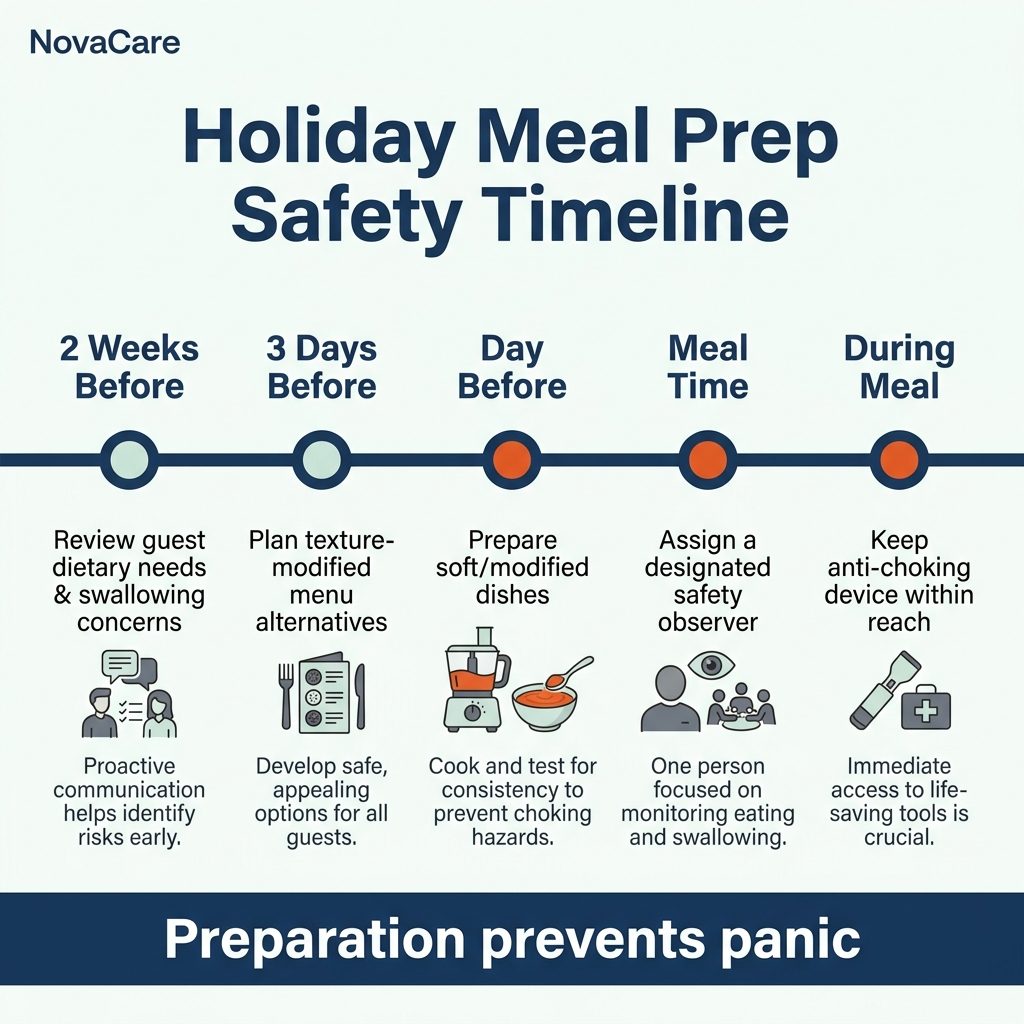
Q11: When should I start preparing for senior holiday safety?
For November/December holidays, ideally start in October:
- October: Coordinate with senior's care team about diet restrictions
- October: Schedule swallowing evaluation if any concerns
- October: Review medications with pharmacist
- Early November: Plan menu around senior's needs
- Early November: Order anti-choking device (NovaCare 2-pack covers home + travel)
- 1 Week Before: Practice using device with family members
- Day Before: Confirm transport logistics, medications
- Day Of: Final medication check, posture preparation
For families gathering at multiple homes, equipment in each location is essential. The 2-pack pricing ($119.98 for two) makes this affordable.
Q12: What menu modifications help most?
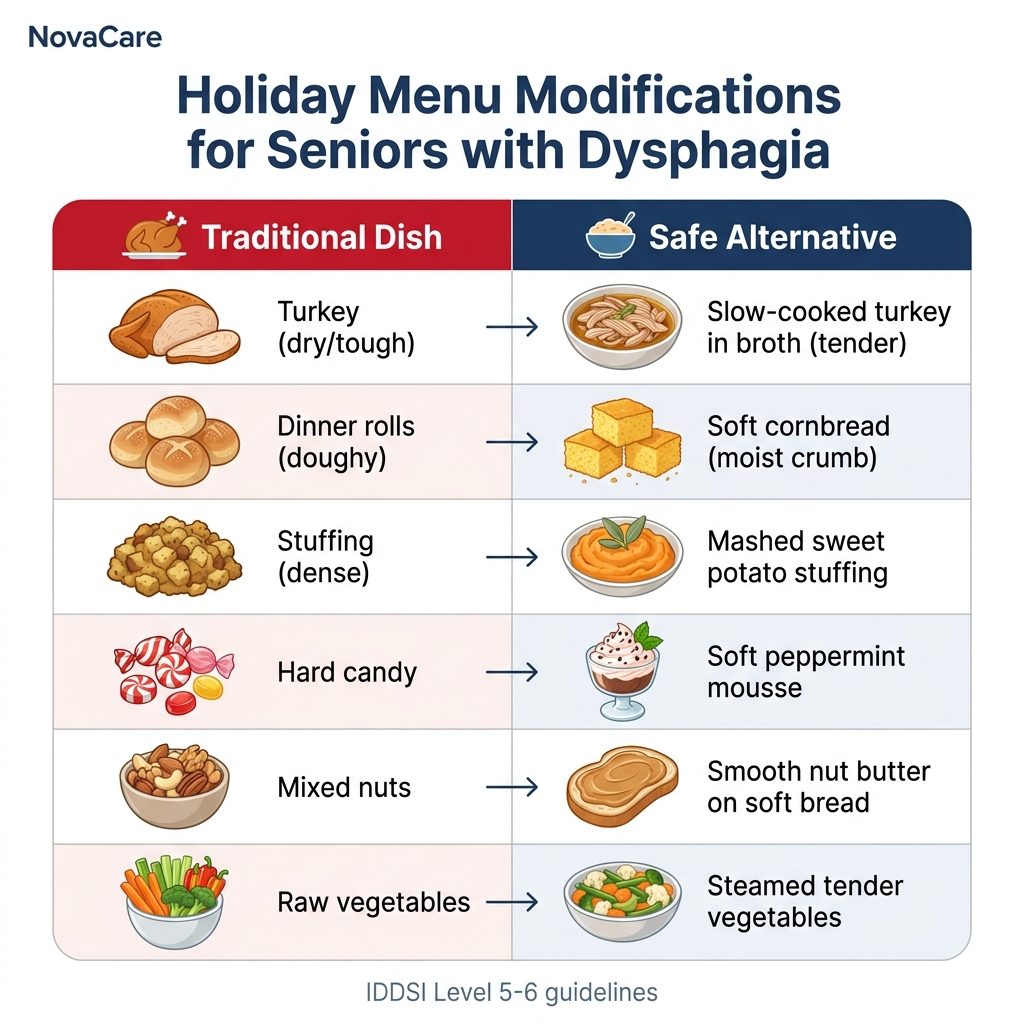
Maximum-impact modifications:
- Cut all meat extra-small — Pinky-fingernail size pieces
- Use plenty of gravy — Lubricates dry foods
- Skip white bread/rolls — Or offer alternatives
- No popcorn appetizers — Or hard candy bowls
- Modify nuts/dried fruit — Cut, not whole
- Fork-mash side dishes — Easier swallowing
- Skip steak unless very tender — Slow-cooked best
- Quarter grapes for dessert — Never whole
- Soft pies preferred — Skip hard cookies
- Have backup dish — Soft, safe option always available
Frame to senior: "I'm bringing your favorite dish — and a softer version of [hard food] just for you because I read it's safer."
Q13: What positioning matters at the dinner table?
Positioning is critical:
- Sit fully upright at 90 degrees — Not reclined
- Both feet on floor — Or footrest if needed
- Plate at correct height — Not too low (encourages slumping)
- Chair with back support — Not casual chairs
- Stay upright 30 minutes after — Don't immediately recline for nap
- Tuck chin slightly when swallowing — Helps direct food correctly
- Turn head to weaker side if stroke survivor
The "casual family room" Christmas dinner where Grandpa eats from a TV tray while reclined in his recliner is dangerous. Insist on proper dining seating.
Q14: How do I address dietary restrictions without offending senior?
Sensitive approach:
- Frame as "extra care," not "you can't have"
- Make modifications part of overall menu — Don't single out senior
- Pre-cut at kitchen, serve normally — Less obvious
- Have senior's favorite foods prepared safely — Don't restrict, modify
- Acknowledge their independence — "I just want you to enjoy without worry"
- Use medical framing — "Your doctor recommended these textures"
Many seniors actually feel relieved when family proactively addresses concerns they've quietly carried.
Q15: What about the senior with dementia?
Dementia patients require additional precautions:
- 72.4% of dementia patients have dysphagia (Frontiers in Neurology)
- Dementia affects awareness — Senior may forget to chew thoroughly
- Pacing concerns — May eat too fast or too slow
- Distraction issues — Family chaos worsens performance
- Antipsychotic medications — Often prescribed for behavior, increase choking risk
For dementia seniors:
- Quieter eating environment if possible
- Designated meal supervisor (one specific adult child)
- Verbal cues: "Take a small bite, chew well, swallow"
- Soft texture by default
- Equipment within arm's reach
- Skip alcohol
Section 4: During the Holiday Meal (5 Questions)
Q16: Who should be designated to watch senior?
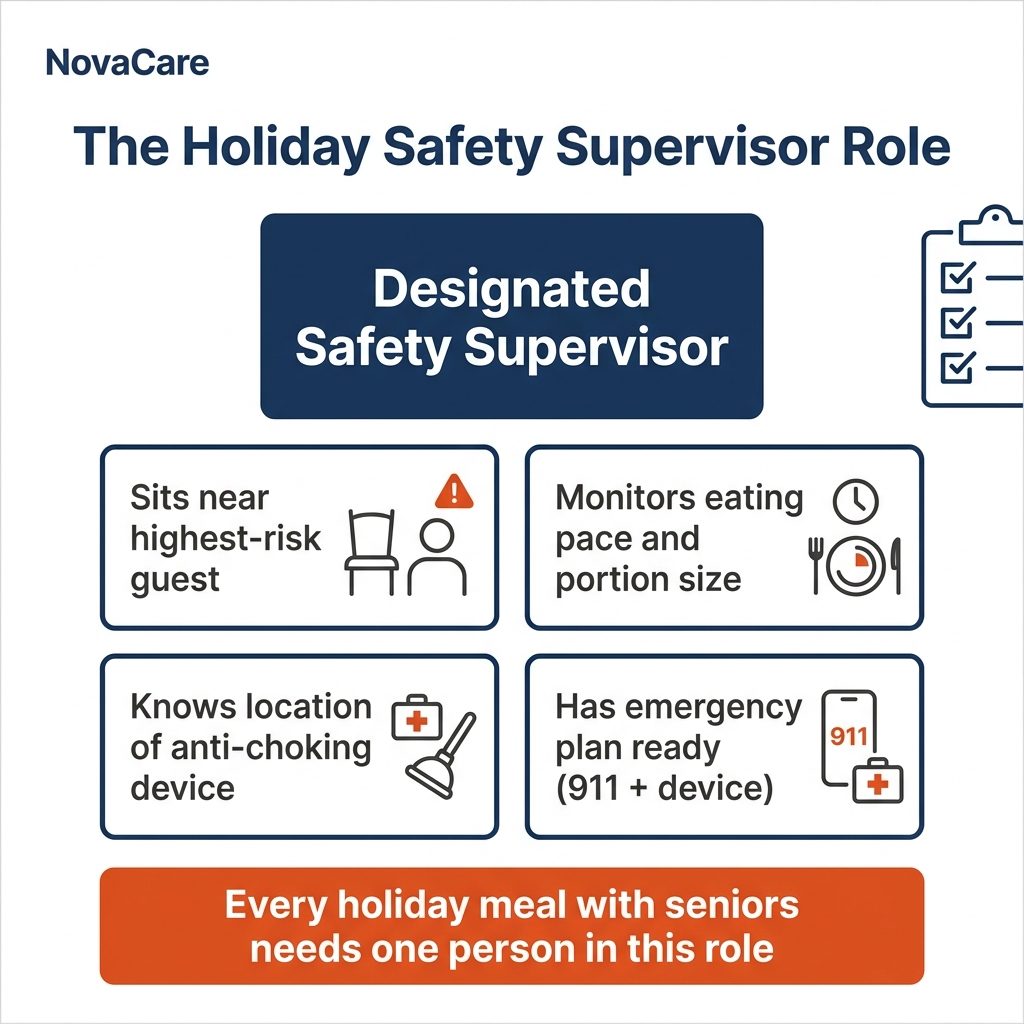
One specific adult child should be designated meal supervisor for senior. Their responsibilities:
- Sit next to senior
- Pace senior's eating
- Monitor for distress signs
- Keep their phone away
- Limit their wine consumption
- Know location of anti-choking device
- Trained on basic Heimlich
Rotate this responsibility across multi-day holidays so no one feels burdened. But always have ONE specific person, never "everyone watching."
Q17: What signs should I watch for?
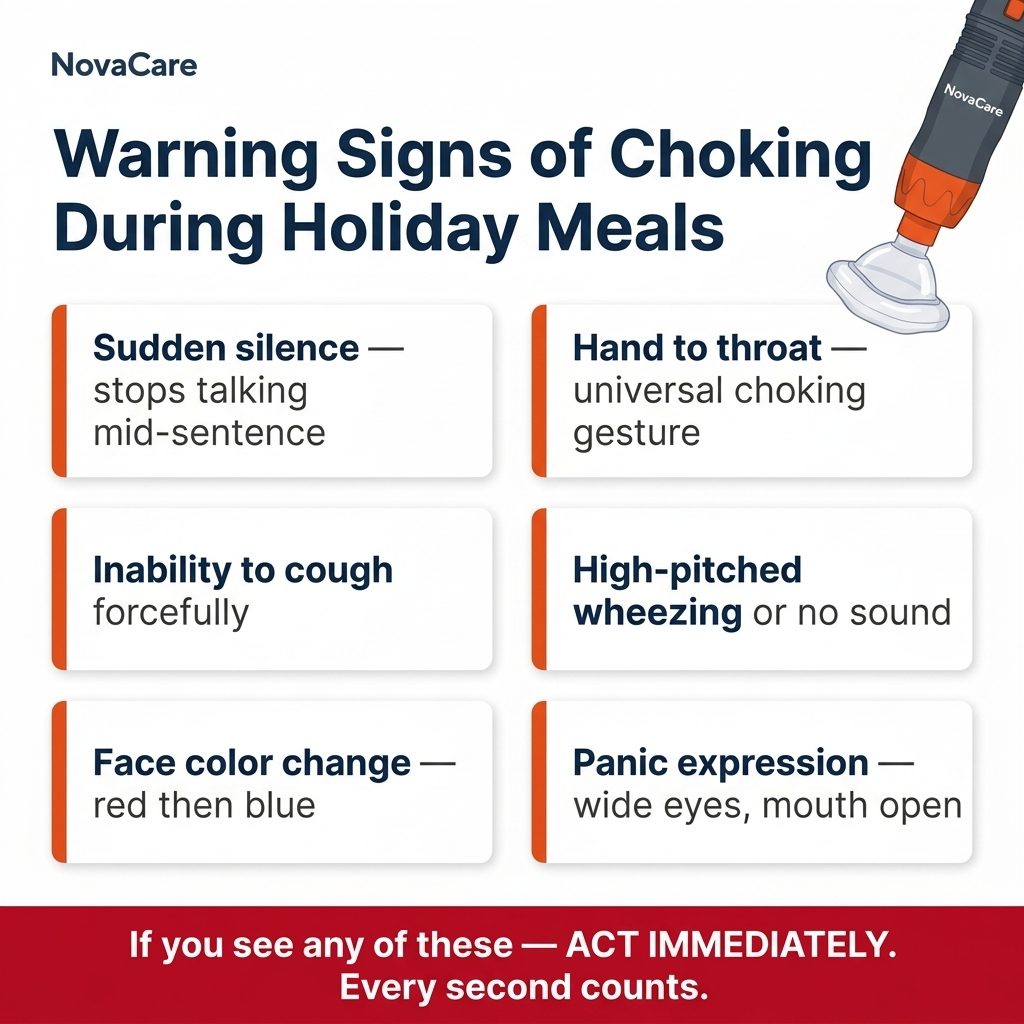
Distress signals:
- Universal sign of choking — Hands at throat
- Sudden silence after talking
- Inability to make sound
- Panicked eyes
- Pale or bluish color
- Standing up suddenly
Subtle signs (less obvious):
- Sudden coughing during meal
- Wet/gurgly voice changes
- Eyes watering
- Reaching for water urgently
- Leaving table abruptly
- Touching neck/chest
Read our complete guide on signs of choking for detailed recognition.
Q18: What about silent aspiration during the meal?
Silent aspiration is exactly what its name implies — silent. The senior may show no signs while eating.
Watch for these during/after meal:
- Wet voice when speaking after eating
- Frequent throat clearing
- Pocketing food in cheeks
- Persistent feeling of food stuck
- Subtle breathing changes
If any of these appear during the meal, gently encourage:
- Slower pace
- Smaller bites
- More fluid sips
- Sit fully upright
- Pause between bites
Q19: Where should the anti-choking device be during dinner?
Equipment placement strategy:
- One device in dining room — Within 10 feet of senior
- One device with traveling caregiver — In purse/bag if possible
- Multiple seniors — Consider one device per senior
- Multi-day holiday — Keep accessible at all locations
- NOT in another room — 4-minute brain damage window
The 2-pack ($119.98 for two devices) covers most family scenarios efficiently.
Q20: Should I tell the senior I have an anti-choking device?
Generally yes — but frame it appropriately.
Effective framing:
- "I keep one of these in the kitchen, like a fire extinguisher — just in case"
- "I read about these and got one for the family — better to have and not need"
- "This is becoming standard for households with kids/seniors"
Avoid alarmist framing:
- "Because you might choke" (creates anxiety)
- "With your medical conditions..." (singles them out)
Many seniors actually appreciate that family takes preventive action — it acknowledges the fear they've quietly carried while taking pressure off them to be the watchdog.
Section 5: Post-Holiday Vigilance (5 Questions)
Q21: What should I watch for in the days after the holiday?
Aspiration pneumonia develops 24-72 hours after the aspiration event. Watch for:
- Persistent cough (different from baseline)
- Low-grade fever
- Shortness of breath
- Increased fatigue
- Chest pain with deep breaths
- Loss of appetite
- Confusion or delirium (often the FIRST sign in elderly)
- Decreased activity level
If your senior parent had any choking moment during the holiday meal — even one they brushed off — monitor closely for the next 5 days. Many "post-holiday pneumonia" cases are actually aspiration events.
Q22: When should I push for medical evaluation?
Take immediate action if any of:
- New-onset confusion or disorientation
- Difficulty breathing at rest
- Fever with cough
- Decreased oxygen saturation (if you have pulse oximeter)
- Inability to drink fluids
- Sudden energy decline
For seniors, aspiration pneumonia can progress from "feeling tired" to ICU-level severity within 48 hours. Earlier evaluation is always better.
Q23: How do I bring up the holiday choking conversation post-event?
If a near-choking happened, this is actually a teaching moment opportunity:
- Don't blame — "It happens, but let's prevent next time"
- Discuss what happened — Helps everyone learn
- Schedule swallowing evaluation — Not negotiable
- Review medications — Pharmacist consultation
- Equipment readiness — Anti-choking device in usual home
- Diet adjustments — Going forward
- Family communication — Tell other adult siblings
One incident is a warning. Multiple incidents are imminent emergency.
Q24: How do I plan for next year?
Build a senior-safe holiday system:
- Standard menu rotations — Senior-safe versions of favorites
- Designated supervisor schedule — Pre-planned rotation
- Equipment locations mapped — Each gathering location
- Medication management protocol — Travel coordination
- Care facility coordination — Communication with their team
- Family education — Annual refresher on basic Heimlich + device use
- Documentation — Save case stories shared with family
The first year requires effort. Subsequent years become routine.
Q25: Why is this conversation difficult for adult children?
Confronting senior parent vulnerability is emotionally complex:
- Acknowledges parent's mortality
- Takes time to plan/coordinate
- Risks creating tension
- Requires others (doctors, pharmacists, caregivers) cooperation
- Costs money (equipment, professional consultations)
- Feels like "treating parent like child"
But families who do this work consistently report:
- Greater peace during gatherings
- Less guilt after
- More quality time (not lost to crisis)
- Stronger family bonds
- Better outcomes
- Many extra years of holiday memories
The alternative — losing parent to a preventable holiday choking incident — is far worse than the awkward conversation.
For Adult Children: A Letter to You
This year, your parent will be at your holiday table. Maybe many more years too. Maybe just this one.
You can't predict when they'll be gone. You can predict that holiday meals carry compound risk for elderly choking emergencies. You can predict that 8x the death rate after 65 doesn't pause for sentiment.
You can also predict this: equipment readiness costs $63.98 and free shipping. A 2-pack covers your home plus theirs for $119.98. That's less than what most families spend on holiday flowers.
Save #156 was a Tuesday-night dinner. Same meal Harold B. had eaten 312 times before. The 313th time, a piece went the wrong way. He was alone. He used the device his daughter mailed him for Christmas — sitting in his drawer for 10 weeks.
His daughter got that package back as a thank-you. She got more Christmases.
What if your gift this year was the kind your parent might unwrap, place in a drawer, and forget about — until the day it saves their life?
→ Get NovaCare for Your Parent — $63.98 single · $119.98 2-pack
The 2-pack covers their home + your home for visits.
The Bottom Line
Holiday family gatherings carry compound choking risks for seniors that adult children rarely consider. Adults over 65 die from choking at 8x the rate of younger adults. 45% of deaths happen at home. Holiday foods are leading culprits. Family distraction makes silent events go unnoticed.
The strategy: pre-holiday planning + meal modifications + designated supervisor + equipment readiness + post-holiday vigilance.
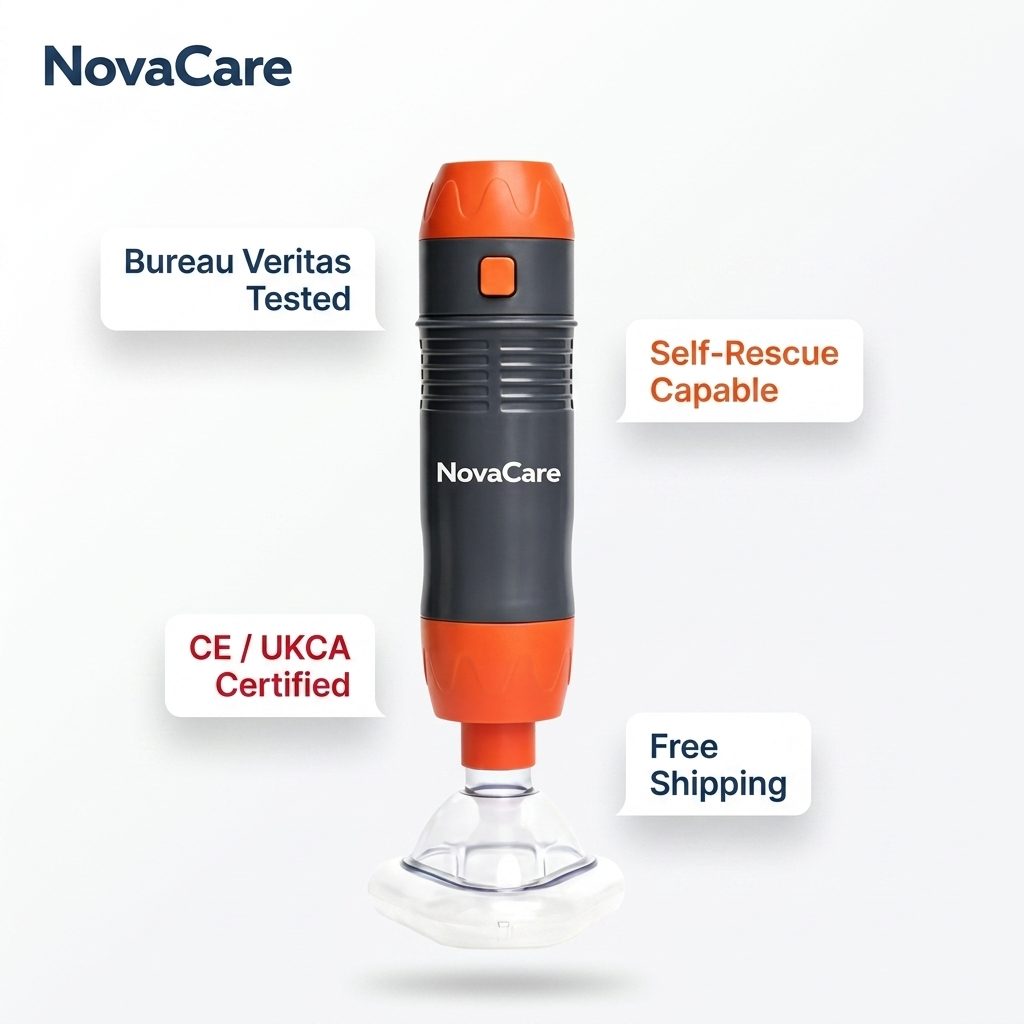
- ✅ Bureau Veritas Tested (Report BV2500728QN7119)
- ✅ 70 kPa Medical-Grade Suction (Independently Verified)
- ✅ IP65 Rated (Dust & Water Resistant)
- ✅ CE & UKCA Certified
- ✅ 20 Documented Saves in 2026
- ✅ 2 Senior Self-Rescues (#156, #162)
- ✅ Reusable Design (Not Single-Use)
- ✅ Mechanical One-Button (No Batteries)
- ✅ Self-Rescue Capable
- ✅ $63.98 single · $119.98 2-pack
- ✅ Free US Shipping
- ✅ 90-Day Money-Back Guarantee
→ Get NovaCare at novacareus.com
📖 Related: Anti-Choking Device for Seniors: 30 Questions Answered
📖 Related: 10 Foods Most Likely to Cause Choking
📖 Related: Aspiration Pneumonia in Seniors
📖 Related: Signs of Choking: Recognize It in 5 Seconds
📖 Related: NovaCare 2026 Lives Saved Report