


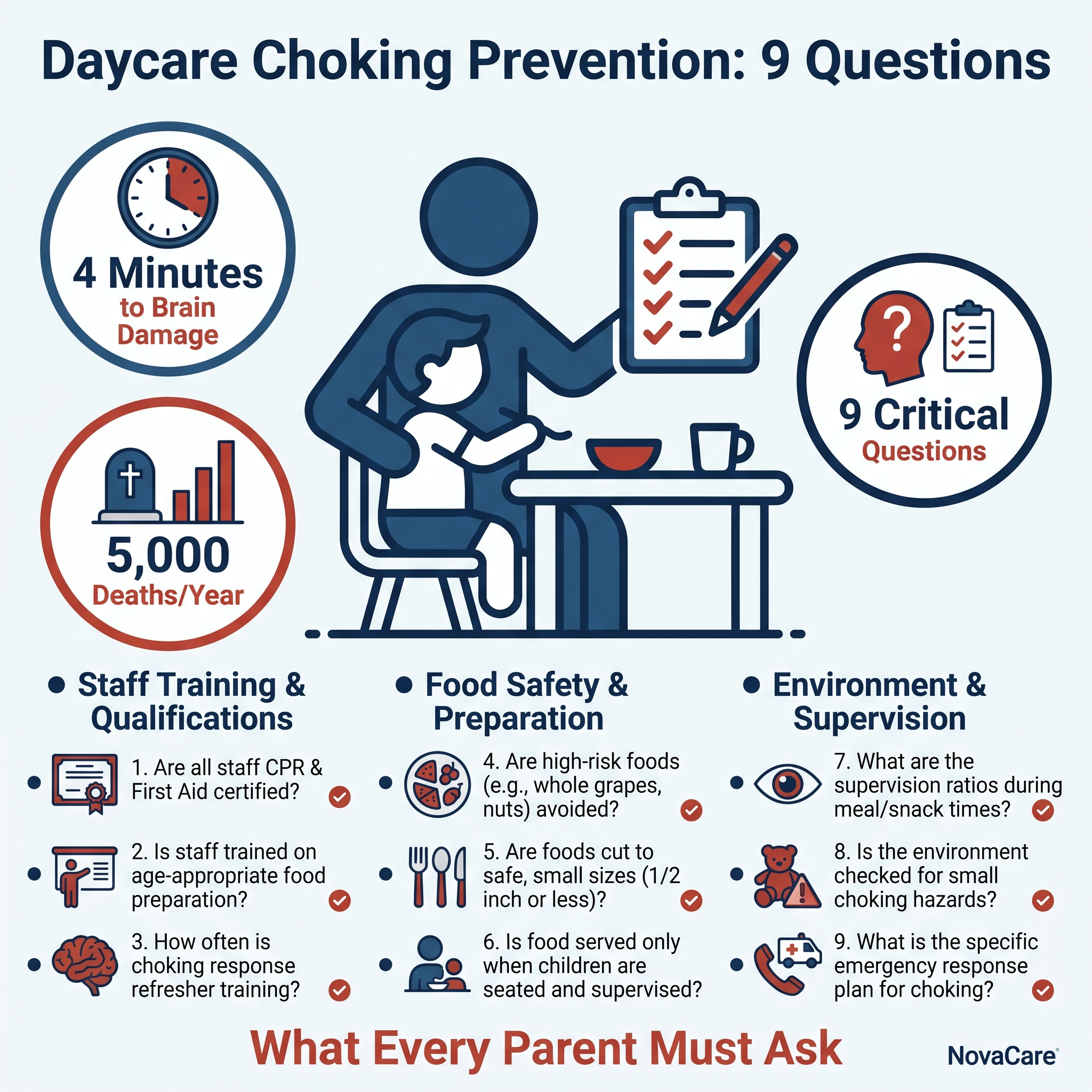
Quick Answer
Most parents tour daycares asking about curriculum, nap schedules, and teacher ratios. Almost none ask about choking emergency protocols — even though choking kills one American every 90 minutes. Here's the truth: the daycare's response in the first 4 minutes determines whether your child survives a choking incident with zero brain damage or faces permanent consequences.
- Choking is the 4th leading cause of unintentional injury death in children under 4 (CDC)
- Brain damage begins at 4 minutes — average ambulance response is 7-10 minutes
- Most daycares have NO mechanical anti-choking device on premises
- Save #172 involved a family gathering where a mechanical device saved a toddler when back blows failed
- These 9 questions will tell you everything about whether a daycare can protect your child
This guide takes 4 minutes to read. That is exactly how long you have.
The Story That Changed Everything
It was supposed to be a happy Sunday afternoon. Save #172 happened at a family gathering — a backyard barbecue with cousins, grandparents, and children running between the tables. A 3-year-old grabbed a piece of hot dog from an unattended plate. Within seconds, silence replaced laughter.
The child's grandmother noticed first. No coughing. No crying. Just wide eyes and hands clutching at her throat. The universal choking sign that every parent prays they'll never see.
The child's uncle attempted back blows. Five firm strikes between the shoulder blades. Nothing. The child's lips began turning blue. Panic spread through the family as someone fumbled with a phone to call 911.
Then the grandmother remembered. Two weeks earlier, her daughter had given her a NovaCare anti-choking device — a mechanical suction device she'd tucked into her purse "just in case." She retrieved it in seconds, positioned the mask over the child's face, and pressed the single button.
The hot dog piece — nearly two inches long — shot out onto the grass. The child gasped, coughed twice, and began crying. The entire incident lasted 47 seconds from obstruction to clearance. The family made the good call that day.
"I still think about what would have happened if we didn't have that device," the grandmother later reported. "Back blows weren't working. We were losing her."
This story isn't just about one family. It's about every parent dropping their child off at daycare tomorrow morning, trusting strangers to protect their most precious person. The question is: does your daycare have a plan — and the tools — to handle what this family faced?
The #1 Rule: Most Daycares Are Unprepared for True Choking Emergencies
Most parents expect licensed daycares to have comprehensive choking emergency protocols. This is wrong.
Here's what a standard daycare license requires: basic CPR certification for staff, updated every two years. A first aid kit with bandages and antiseptic. Posted emergency numbers. That's largely it. There is no federal requirement — and most states have none — mandating mechanical anti-choking devices or advanced airway obstruction training.
The result? When a real choking emergency happens, staff default to the Heimlich maneuver and back blows. Both techniques are excellent for mild obstructions. Both have documented failure rates when obstructions are severe or deeply lodged. According to the American Red Cross, the Heimlich maneuver is particularly ineffective when performed on infants under 12 months — the very children who face the highest choking risk.
The National Center for Health Statistics reports over 5,000 Americans die from choking each year. Children under 4 represent one of the highest-risk groups, with food items like hot dogs, grapes, and popcorn causing the majority of fatal incidents.
The lesson from Save #172 is clear: traditional techniques saved about 80% of choking victims. But for the other 20%, you need a backup plan. The question is whether your daycare has one.
The 9 Critical Questions Every Parent Must Ask
Question 1: What Is Your Exact Choking Response Protocol?
This question reveals whether a daycare has actually thought through emergency scenarios or is simply relying on "call 911 and hope." Listen for specifics. A prepared daycare will describe a step-by-step protocol: who assesses the child, who calls emergency services, who retrieves emergency equipment, who clears other children from the area. Vague answers like "our staff is trained" indicate a daycare that hasn't practiced real scenarios. According to emergency medicine research, practiced protocols reduce response time by 40-60% compared to improvised responses. Those seconds matter when brain damage begins at 4 minutes.
Question 2: How Many Staff Members Are Currently CPR Certified?
Not "how many were certified at hiring" — how many are certified right now, today. CPR certification expires every two years, and busy daycares often let certifications lapse between renewal dates. Ask for the actual number and the most recent certification dates. A well-run daycare will know this immediately because they track it actively. If the administrator has to "check the files," that's a red flag. You want at least two CPR-certified staff members on duty at all times, because emergencies don't wait for the one certified person to return from lunch break.
Question 3: Do You Have a Mechanical Anti-Choking Device On Site?
This is the question most daycares cannot answer affirmatively — and the one that matters most. Traditional choking response (back blows and Heimlich) works for most obstructions but fails for severe blockages. A mechanical anti-choking device like NovaCare provides backup when traditional methods fail. NovaCare is a mechanical suction device — one-button design, operated with one hand, no batteries or charging required, self-rescue capable. It's Independently tested by Bureau Veritas and Bureau Veritas tested (Report BV2500728QN7119), delivering up to 70 kPa of suction. At $63.98 for a single unit or $119.98 for a 2-pack, it's a minimal investment for a daycare — yet most don't have one.
Question 4: What Foods Are Prohibited or Modified?
The American Academy of Pediatrics identifies specific high-risk choking foods: whole grapes, hot dogs (sliced in rounds), popcorn, whole nuts, hard candies, raw carrots, and chunks of cheese or meat. A safety-conscious daycare will either prohibit these foods entirely or have documented modification protocols (grapes quartered lengthwise, hot dogs sliced lengthwise then into small pieces). Ask to see their food policy in writing. If they can't produce a written policy, they're relying on individual staff judgment — which is inconsistent and dangerous.
Question 5: How Do You Handle Children Who Are Still Learning to Chew?
Children between 12-36 months are in a critical transition period. They have teeth and want "big kid food," but their chewing skills and airway size make them extremely vulnerable. A prepared daycare will describe age-appropriate food textures, supervised mealtimes with specific adult-to-child ratios, and protocols for children who stuff food or eat too quickly. CDC data shows this age group has choking rates 2-3× higher than older children. The daycare's answer to this question reveals whether they understand developmental choking risk.
Question 6: What Happens in the First 60 Seconds of a Choking Emergency?
Time is everything. Ask the daycare to walk you through the first minute. A trained response looks like: 0-10 seconds (recognition and assessment), 10-30 seconds (initial intervention — back blows for infants, Heimlich for toddlers), 30-60 seconds (if unsuccessful, retrieve mechanical device while second staff member calls 911). Listen for role assignments. If one person is supposed to do everything, the protocol will fail under pressure. A daycare that can clearly articulate the first 60 seconds has actually practiced. One that says "we assess and respond appropriately" has not.
Question 7: When Was Your Last Choking Emergency Drill?
Fire drills are required monthly at most daycares. Choking drills? Almost never required. Yet choking emergencies are more common than fires in childcare settings. Ask when staff last practiced a simulated choking response — not CPR class years ago, but an actual drill with a practice mannequin at this facility. If the answer is "we haven't done one" or "I'm not sure," that tells you everything. Skills decay without practice. A staff member who last practiced choking response two years ago in a certification class will hesitate in a real emergency. Hesitation kills.
Question 8: Has Any Child Choked at This Facility? What Happened?
This question will make administrators uncomfortable. Ask it anyway. A daycare that has never had a choking incident in years of operation is either very lucky or very small. What you're listening for is honesty and learning. Did they debrief the incident? Change protocols? Add equipment? A daycare that says "yes, it happened, and here's what we changed" is safer than one that claims perfection. Denial prevents improvement. Growth requires acknowledging risk.
Question 9: May I See Your Emergency Equipment and Where It's Stored?
Ask for a tour of emergency equipment. Where is the first aid kit? How quickly can someone reach it from the eating area? Is there a mechanical anti-choking device designed for seniors or children? (NovaCare works for all ages over 12 months.) If equipment exists but is stored in a locked closet on the other side of the building, it's useless in an emergency. You want equipment within arm's reach of where children eat. Every second spent walking to a closet, finding keys, and returning is a second your child isn't breathing. Brain damage begins at 4 minutes. That clock starts the moment obstruction occurs.
Daycare Choking Preparedness: What You Should Find vs. What You'll Actually Find
| Safety Factor | Gold Standard Daycare | Average Daycare | Why It Matters |
|---|---|---|---|
| Choking Protocol | Written, posted, practiced quarterly | Verbal, inconsistent, rarely practiced | Practiced protocols reduce response time by 40-60% |
| Anti-Choking Device | Mechanical device within 15 feet of eating area | None on premises | Backup when traditional methods fail |
| Staff Certification | 100% current CPR, documented | Some current, some expired | Expired skills create false confidence |
| Food Policy | Written prohibition + modification protocols | Informal, staff discretion | Consistency prevents gaps |
| Drill Frequency | Monthly with documentation | Never or only at initial training | Skills decay within months without practice |
| Action Needed | Enroll with confidence | Request improvements or seek alternatives | Your child's safety is non-negotiable |
The 30-Second Daycare Choking Safety Test
When you tour a daycare, you can assess their choking preparedness in 30 seconds with these five observations:
1. Look at the eating area. Is there emergency equipment visible within arm's reach, or is the nearest first aid kit down a hallway? If you can see equipment, check: is it a mechanical anti-choking device or just bandages?
2. Watch a mealtime if possible. What's the adult-to-child ratio during eating? One adult per 4 children is good. One adult per 8+ is dangerous. Are adults actively watching or doing paperwork?
3. Check the menu. Do you see high-risk foods (whole grapes, round hot dog slices, popcorn)? If so, do you see evidence of modification protocols, or are these foods served as-is?
4. Ask the nearest staff member. "What would you do if a child in your care started choking right now?" A trained staff member will give immediate, specific steps. An untrained one will say "call for help" or look uncomfortable.
5. Trust your gut. If the administrator deflects your safety questions, gets defensive, or can't provide specific answers, your instincts are telling you something. Listen.
If you find three or more concerns: Monitor this daycare closely or seek alternatives. If you find zero concerns: You've likely found a safety-conscious facility worth your trust.
Special Considerations for High-Risk Children
Infants Under 12 Months
This age group cannot receive the traditional Heimlich maneuver — their bodies are too small and fragile. Instead, infants require a specific sequence of back blows and chest thrusts. Ask any daycare caring for infants: "Show me exactly how you would respond to an infant choking." Staff should be able to demonstrate the position (face-down on forearm, head lower than chest) and technique (heel of hand between shoulder blades) immediately. Hesitation indicates insufficient training. NovaCare's mechanical suction approach works for ages 12 months and up, which means infants under 12 months rely entirely on manual techniques — making staff training even more critical for infant rooms.
Children with Developmental Delays
Children with conditions affecting motor control, swallowing, or sensory processing face elevated choking risk. If your child has any developmental considerations, ask the daycare: "What modifications do you make for children with [specific condition]?" You should hear about texture modifications, additional supervision during meals, and communication with occupational therapists or feeding specialists. A daycare that says "we treat all children the same" is not accommodating special needs — they're ignoring them. You can read more about anti-choking devices for people with Parkinson's to understand how neuromuscular conditions affect choking risk.
Toddlers 12-36 Months
This is the highest-risk age for choking. Children this age are mobile enough to find food on their own (dropped items, other children's plates) but lack the judgment to eat safely. They're also prone to eating while walking, running, or laughing — all behaviors that increase aspiration risk. A daycare should have specific toddler protocols: supervised eating only (no walking with food), bite-sized portions, extended mealtimes to prevent rushing, and immediate cleanup of dropped food. The CDC identifies this age group as requiring the most vigilant supervision during meals.
Real Save Story: Why Every Second Counts
Save #200 happened at a gym — an adult incident that illustrates why mechanical backup matters everywhere, including daycares. A man in his 40s was eating a protein bar between sets when a piece lodged in his airway. Another gym member attempted the Heimlich maneuver. It didn't work. The victim began losing consciousness.
A gym staff member had recently convinced management to add a NovaCare device to the wall-mounted emergency equipment. She retrieved it, positioned the mask, and pressed the single button. The obstruction — a compressed mass of protein bar — was extracted within 8 seconds. The man recovered completely.
"We always had a defibrillator," the gym manager reported later. "It never occurred to me that we needed something for choking. Now I tell every business owner: if people eat at your location, you need this device."
Daycares are places where children eat multiple times daily. The logic is identical: if your daycare has a first aid kit and emergency contact numbers, they should have a mechanical anti-choking device. At $63.98, there is no budget excuse. You can review the 2026 lives saved report to see the full scope of documented NovaCare saves.
What to Do If Your Daycare Fails the Test
If you've asked the 9 questions and your daycare's answers concern you, you have three options:
Option 1: Request Improvements. Write a formal email to daycare administration requesting specific changes: purchase a mechanical anti-choking device, implement quarterly choking drills, update food policies. Many daycares will respond positively — they want to do better but haven't been asked. Offer to help by providing resources or even donating a NovaCare device yourself (the $119.98 2-pack means one for daycare, one for home).
Option 2: Escalate Concerns. If administration is dismissive, contact your state's childcare licensing agency. While most states don't require anti-choking devices, licensing agencies track complaints and patterns. Your documented concern creates a record that may influence future inspections or requirements.
Option 3: Seek Alternatives. If the daycare refuses to improve and your concerns are significant, consider other options. The inconvenience of finding new childcare is real. So is the risk of leaving your child somewhere unprepared for emergencies. Only you can weigh this tradeoff.
Regardless of which option you choose, ensure your child's other environments are protected. Request that grandparents and caregivers have NovaCare devices. Keep one in your own diaper bag for travel. Learn to recognize the signs of choking so you can intervene before permanent damage occurs.
When to Call 911 at a Daycare
- ☑️ Call 911 if: The child is unconscious or becoming unconscious
- ☑️ Call 911 if: Back blows and Heimlich have failed twice
- ☑️ Call 911 if: You've used a mechanical device and obstruction remains
- ☑️ Call 911 if: The child is breathing but experiencing significant distress after obstruction clears
- ☑️ Call 911 if: You're unsure whether the obstruction is fully cleared
- 🚨 Intervene immediately if: The child cannot cough, cry, or make any sound
- 🚨 Intervene immediately if: The child's lips or face are turning blue
- 🚨 Intervene immediately if: The child is making the universal choking sign (hands to throat)
- 🚨 Intervene immediately if: The child was eating and suddenly goes silent
Remember: calling 911 does not replace immediate intervention. Average ambulance response time is 7-10 minutes. Brain damage begins at 4 minutes. You — or the daycare staff — are the first responder. Call while acting, not instead of acting.
Why NovaCare Belongs in Every Daycare
This is exactly why NovaCare was built. When traditional choking response fails — and it does fail, in approximately 20% of severe cases — families and caregivers need a backup that works immediately.
NovaCare is a mechanical suction device designed for exactly these moments. Its one-button design means even stressed, panicking adults can use it correctly. It operates with one hand, leaving your other hand free to support the child. It requires no batteries and no charging — it's always ready, even if it's been sitting in a drawer for months. It's self-rescue capable, meaning an older child or adult could potentially use it on themselves.
NovaCare is Independently tested by Bureau Veritas. It has been Bureau Veritas tested (Report BV2500728QN7119) and delivers up to 70 kPa of suction — enough to extract obstructions that manual techniques cannot dislodge. With over 200 documented saves and counting, including senior self-rescues by Harold B. (#156) and Dorothy F. (#162), NovaCare has proven itself in real emergencies.
For daycares, the $119.98 2-pack makes sense: one device in the infant/toddler room, one in the preschool eating area. For parents who want to ensure their child is protected everywhere, $63.98 puts a device in your diaper bag, your car, or your home. You can view every documented NovaCare save in 2026 to understand the real-world impact.
A Note for Parents Reading This
If you're reading this article, there's a good chance you're about to trust strangers with your child's life.
That's what daycare is. You're handing your most precious person to people you've interviewed for maybe an hour, toured a facility for maybe 30 minutes, and read reviews that might be curated. And then you're walking away for 8-10 hours.
There are two phone calls you might receive one day:
📞 Call #1 — The bad call: "There's been an incident. Your child choked during lunch. We're so sorry. The ambulance is on the way, but... you should get here as fast as you can."
📞 Call #2 — The good call: "We had a scare today — your daughter choked on some fruit. But the staff used our emergency device and she's completely fine. She's playing right now. Just wanted to let you know."
Save #172 was the good call. A 3-year-old at a family gathering, saved in 47 seconds. Save #200 was an adult at a gym, saved in 8 seconds. These were the good calls.
You cannot control everything that happens when your child is out of your sight. But you can ask the right questions. You can choose facilities that take choking seriously. And you can ensure that wherever your child goes — daycare, grandma's house, the car, vacation — a NovaCare device is within reach.
For $63.98 with free US shipping, you can make sure your family gets the good call. Get NovaCare here →
Why Families Trust NovaCare
- ✅ Bureau Veritas Tested Medical Device
- ✅ Bureau Veritas Tested (Report BV2500728QN7119)
- ✅ 200+ documented saves
- ✅ 2 senior self-rescues (#156 Harold B. · #162 Dorothy F.)
- ✅ 70 kPa Medical-Grade Suction (Independently Verified)
- ✅ IP65 Rated (Dust & Water Resistant)
- ✅ CE & UKCA Certifications In Progress
- ✅ Reusable Design (Not Single-Use)
- ✅ Mechanical One-Button (No Batteries)
- ✅ Self-Rescue Capable
- ✅ $63.98 single · $119.98 2-pack
- ✅ Free US Shipping
- ✅ 90-Day Money-Back Guarantee